
The Professional Voice Check-Up
The Professional Voice Check-Up is a structured assessment of a working voice while it is still healthy. It measures more than thirty parameters in a single visit and produces a written baseline: a detailed record of how your voice performs now.
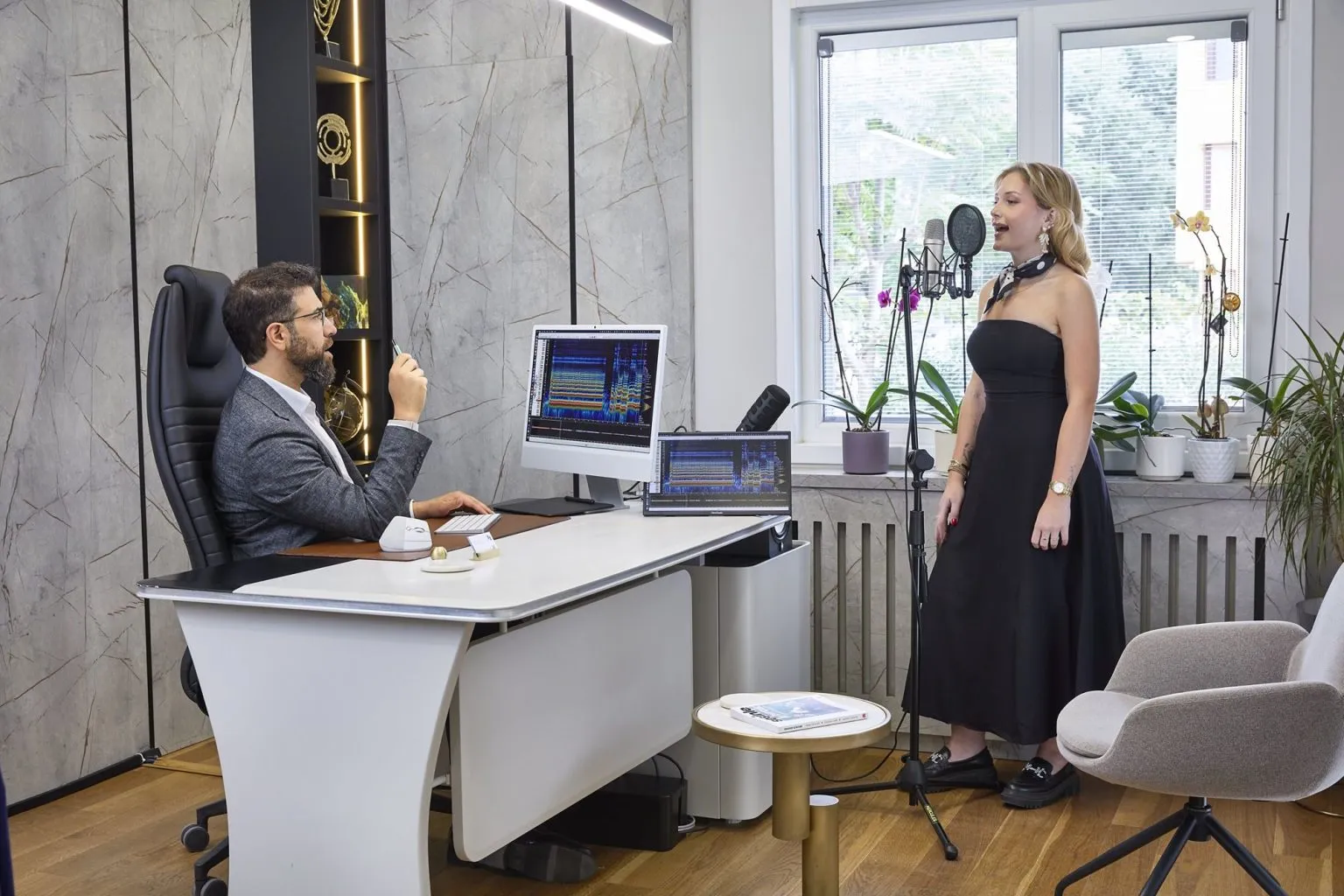
What is it?
Voice assessment usually begins after something has gone wrong. By then the useful comparison, what this particular voice looked and sounded like when it was working well, no longer exists, so clinicians compare the patient against population averages instead. For a professional voice that comparison is weak. A trained singer's normal is not the general population's normal, and a change that matters on stage can sit comfortably inside a normal range.
The check-up exists to fix that. It captures the baseline while the voice is well, so later change is measured against you rather than against an average. It is deliberately not a screening test for disease, and it is not triage. It is a detailed map of a healthy instrument.
The design follows a second principle: the voice is not only the vocal folds. Breath supply, resonance, hearing, and systemic factors such as thyroid function and reflux all shape how a voice performs and how long it lasts. Assessing the folds alone answers a fraction of the question.
Who should consider it?
Singers across genres, actors, voice and dubbing artists, broadcasters, and other professionals whose income depends on vocal reliability. The check-up suits performers who are currently well and want a baseline, those who sense a change they cannot name, and those entering a demanding period of work who want to know where they stand before it begins.

What is assessed?
The visit is structured in stages, and each measurement has a reason.
Clinical interview
Vocal load, performance schedule, technique, history, and current concerns. An opera singer and a dubbing artist carry different risks, and this conversation shapes the rest of the assessment rather than applying a fixed template.
Self-report measures
Validated scales, including the Singing Voice Handicap Index and a performance-ease measure, turn a subjective sense that something has shifted into a comparable score.
Spectral analysis
Real-time visualisation of the frequency content of your voice: harmonic profile and formant structure, the acoustic signature of your particular instrument.
Signal quality and acoustic measures
Objective measures of periodicity and noise (including CPPS, HNR, and GNE), vibrato rate and extent, and overall dysphonia severity. These can register a drift before the ear detects it.
Voice range profile
A two-dimensional map of your full pitch and intensity range, showing where the voice is wide and where it narrows, how register transitions behave, and how smoothly you move from soft to loud. It is the single most informative picture for tracking change over time.
Resonance and projection
Measures of carrying power and spectral balance, including singer's power ratio and long-term average spectrum slope. Loss of resonance balance tends to be compensated by pushing, which accelerates fatigue.

Breath, hearing and the vocal folds
Aerodynamic measures
Breath efficiency: maximum phonation time, s/z ratio, and, where indicated, subglottic pressure and laryngeal resistance. Endurance problems often originate here rather than at the vocal folds.
Hearing evaluation
Extended high-frequency audiometry (into the range damaged first by stage monitors and studio headphones), otoacoustic emissions, speech-in-noise discrimination, and temporal processing. A performer who cannot hear the top of their range accurately begins, without knowing it, to push.
Blood work
Thyroid function, iron status, and other markers relevant to voice. Some voice problems cannot be resolved by technique because their cause is systemic.
Stroboscopic examination
High-resolution recording of vocal fold vibration in slow motion: closure pattern, mucosal wave, symmetry, and any structural change. The recording from a first check-up documents the folds while everything works, and becomes the reference for any future concern.
Final consultation and report
The findings are interpreted together, in the context of your voice and your work, and turned into a written report with recommendations and a follow-up schedule.
Baseline documentation
You receive a comprehensive report, a comparison table of your parameters against normative references, individual recommendations, and a plan for when to repeat the assessment.
Follow-up
Follow-up check-ups are shorter, because the baseline already exists and the useful comparison is now against yourself.
The check-up may find nothing to act on, which is a legitimate and common outcome. It may identify an imbalance that is not yet causing symptoms, for example good acoustic measures alongside poor breath efficiency, which is the kind of finding that becomes vocal fatigue some months later if it is left alone. Where a finding needs treatment, we discuss the options, and where it does not, we say so rather than manufacture an intervention.

Medically reviewed by
Associate Professor Necati Enver, MD
Laryngologist · Founder and Director, Istanbul Voice Center · Reviewed September 2026
General information only. It does not replace an individual assessment. Medical disclaimer
Frequently asked questions
What is a professional voice check-up?
A professional voice check-up is a structured assessment of a healthy working voice. It measures more than thirty parameters in a single visit and produces a written baseline against which future change can be judged.
Why have a voice check-up if nothing is wrong?
Because the most useful comparison, what your own voice looked and sounded like when it was working well, only exists if it was recorded. Without a baseline, later changes are compared against population averages, which are a poor reference for a trained voice.
What is measured in a voice check-up?
Clinical history and vocal load, validated self-report scales, spectral analysis, acoustic and signal quality measures, a voice range profile, resonance and projection measures, aerodynamic breath measures, extended high-frequency hearing evaluation, blood work for systemic factors, and high-resolution stroboscopy, followed by a consultation and a written report.
Why is hearing tested as part of a voice check-up?
Because a performer who cannot hear the top of their range accurately begins, without realising it, to push. High-frequency hearing loss from stage monitors and studio headphones is common and is missed by standard hearing tests.
Know your voice while it is working well
Book the check-up at a quiet point in your season, so the baseline reflects your voice at its best.